Introduction
The AI chatbot world has exploded with options, and keeping track of them all can feel like a full-time job. Between ChatGPT, Claude, Gemini, Grok, and dozens of niche models, most people end up juggling multiple subscriptions just to get the right answer for the right task. That’s the exact problem Poe AI was built to solve. Instead of forcing you to pick one AI company and stick with it, Poe brings nearly every major language model into a single app, letting you switch between them in seconds. In this guide, we’ll break down what Poe AI actually is, how it works, what it costs, and whether it deserves a spot on your phone or desktop.
What Is Poe AI?
Poe stands for “Platform for Open Exploration,” and it was created by Quora, the popular question-and-answer website, under the leadership of co-founder Adam D’Angelo. The platform first launched in December 2022 and opened to the public in early 2023, making it one of the earliest multi-model AI aggregators on the market.
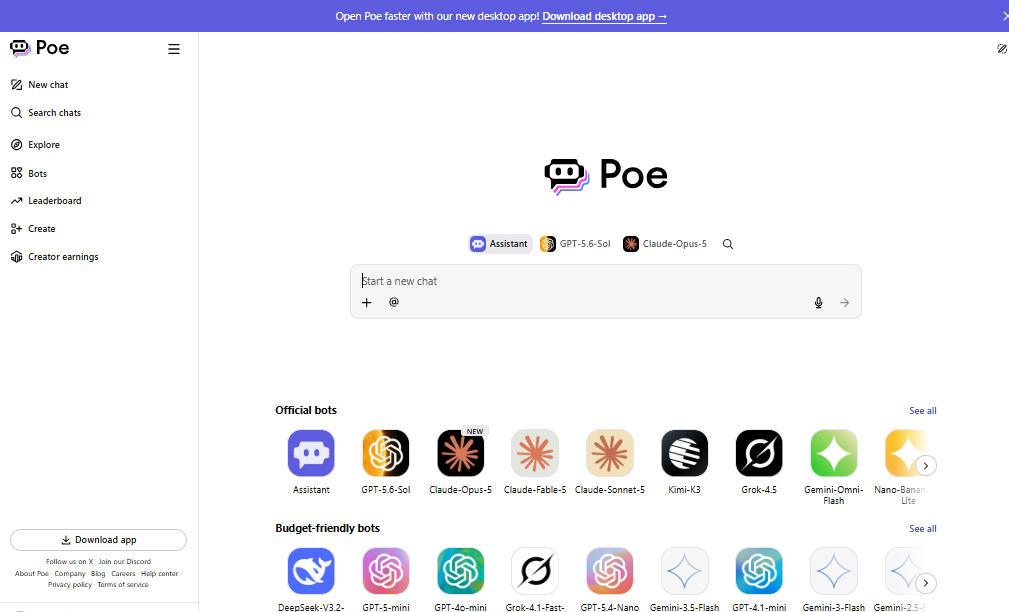
Rather than developing its own foundation model from scratch, Poe acts as a bridge between users and the AI models built by companies like OpenAI, Anthropic, Google, xAI, Meta, DeepSeek, and Mistral. On top of that, it offers image and video generation tools and gives everyday users the ability to build and publish their own custom chatbots without writing a single line of code. In short, Poe is less an AI itself and more a marketplace and control center for AI.
Key Features
- Multi-model access: Chat with GPT, Claude, Gemini, Grok, Llama, and many other models from one login, without separate accounts or apps.
- Model switching mid-conversation: Start a conversation with one model and switch to another instantly to compare answers or tap into different strengths.
- Custom bot creation: Build your own bot using simple prompt instructions or more advanced API-based configurations, then share it publicly or keep it private.
- Image, video, and audio generation: Access popular creative AI tools for generating visuals and media alongside text-based chat.
- Points-based usage system: Instead of separate limits per model, usage is tracked through a shared pool of compute points that different models consume at different rates.
- Synced conversations across devices: Your chat history follows you between web, desktop, and mobile.
- Creator monetization: Bot creators can earn a share of revenue generated by users interacting with their custom bots.
Benefits
The biggest benefit of Poe is convenience. Instead of paying for and managing four or five separate AI subscriptions, you get access to most of them under one bill and one interface. This makes it easy to compare how different models handle the same prompt, which is especially useful for writers, researchers, developers, and anyone who wants a second (or third) opinion before trusting an AI-generated answer. The custom bot builder also lowers the barrier for non-technical users who want a tailored assistant without touching an API or writing code.
Pros & Cons
Poe’s biggest strength — variety — comes with a few trade-offs. New model releases sometimes appear on Poe slightly later than on their native apps, and the shared points system means heavy users of premium models can burn through their monthly allowance faster than expected.
Pricing
Poe operates on a freemium model with a shared “compute points” system. Free users get a limited daily point allowance for basic models. Paid tiers unlock significantly larger allowances and access to premium, high-end models. As of 2026, the general structure looks like this:
| Plan | Approx. Monthly Price | Points Allowance |
|---|---|---|
| Free | $0 | Limited daily points, basic models only |
| Starter | ~$4.99/month | ~10,000 points/day |
| Premium | ~$19.99/month | ~660,000–1,000,000 points/month |
| Premium Plus | ~$49.99/month | ~1.65 million points/month |
| Pro | ~$99.99/month | Higher point allocation for heavy use |
| Pro Max | ~$249.99/month | ~8.25 million points/month |
Annual billing typically comes with a discount of around 17% compared to paying monthly. Pricing and point allocations are subject to change, so it’s worth checking Poe’s official site before subscribing.
System Requirements
Poe doesn’t require specialized hardware. If your device can run a modern web browser or install a standard mobile app, you can run Poe. A stable internet connection is required since all processing happens on remote servers, not on your device.
Supported Platforms
Poe AI is available on:
- Web (any modern browser)
- Windows (desktop app)
- macOS (desktop app)
- Android (mobile app)
- iPhone/iOS (mobile app)
Conversations sync automatically across all of these platforms when you’re logged into the same account.
How to Use Poe AI (Step-by-Step)
- Create an account: Visit Poe’s website or download the app, then sign up using an email address or a supported social login.
- Explore the free tier: Start chatting with basic models to get a feel for the interface before committing to a paid plan.
- Pick a model: Browse the model list and select one suited to your task — a general chat model for conversation, a coding-focused model for programming, or a creative model for image generation.
- Start chatting: Type your prompt just like you would in any chatbot. Switch models anytime using the selector at the top of the chat.
- Try or build a custom bot: Browse community-created bots for specialized tasks, or use the “Create Bot” tool to build your own using a simple prompt template.
- Upgrade if needed: If you find yourself running out of daily points, review the paid tiers and pick one that matches your usage habits.
Best Use Cases
Poe works particularly well for comparing how different AI models respond to the same question, drafting and refining written content, brainstorming ideas, casual research, coding help, and generating images or short creative pieces. It’s less suited to businesses that need to deploy AI agents directly into a website or customer support workflow, since Poe is built primarily for direct, conversational use rather than automation infrastructure.
Who Should Use It?
Poe is a strong fit for individuals who use AI regularly and want flexibility without paying for multiple subscriptions. Writers, students, developers, and researchers who like comparing outputs from different models will get the most value. It’s less ideal for enterprises with strict data governance needs or businesses looking to build automated, multi-channel AI agents, since more specialized platforms handle those use cases better.
Alternatives
Popular alternatives to Poe include direct subscriptions to ChatGPT Plus, Claude Pro, and Gemini Advanced, as well as other aggregator-style platforms and no-code AI agent builders aimed at business automation rather than personal chat.
Feature Comparison Table
| Feature | Poe AI | Native Single-Model App (e.g., ChatGPT Plus) |
|---|---|---|
| Access to multiple AI models | Yes | No (single provider) |
| Custom bot creation | Yes | Limited or provider-specific |
| Cross-platform sync | Yes | Yes |
| Image/video generation | Yes | Varies by provider |
| Latest model release speed | Sometimes delayed | Usually first access |
| Single subscription for multiple models | Yes | No |
Pros & Cons Table
| Pros | Cons |
|---|---|
| Access to dozens of AI models in one place | New models may arrive slightly later than on native apps |
| Easy model comparison and switching | Shared points system can be confusing for new users |
| No-code custom bot creation | Heavy usage of premium models drains points quickly |
| Available on all major platforms | Not built for enterprise-grade automation |
| Free tier available to try before paying | Some advanced features require higher-tier plans |
Pricing Table
| Plan | Price | Best For |
|---|---|---|
| Free | $0 | Casual, occasional use |
| Starter | ~$4.99/month | Light daily use |
| Premium | ~$19.99/month | Most individual users |
| Premium Plus | ~$49.99/month | Frequent, heavier use |
| Pro | ~$99.99/month | Power users |
| Pro Max | ~$249.99/month | High-volume use cases |
FAQs
1. Is Poe AI free to use? Yes, Poe offers a free tier with a limited daily point allowance for basic models. No credit card is required to start.
2. What AI models can I access on Poe? Poe gives you access to a wide range of models, including those from OpenAI, Anthropic, Google, xAI, Meta, and others, alongside image and video generation tools.
3. Can I create my own chatbot on Poe? Yes. Poe’s “Create Bot” feature lets users build custom bots using simple prompts, with more advanced API-based options available for developers.
4. Is Poe available on mobile devices? Yes, Poe has apps for both Android and iOS, in addition to its web and desktop versions for Windows and macOS.
5. How does Poe’s pricing work? Poe uses a subscription model combined with a points system. Each paid tier includes a set monthly (or daily) point allowance, and different models consume points at different rates.
6. Is Poe better than subscribing directly to ChatGPT or Claude? It depends on your needs. If you value variety and want to compare multiple models without multiple subscriptions, Poe is often a better value. If you need the very latest features from one specific provider, a native subscription may still be preferable.
7. Who created Poe AI? Poe was created by Quora, the question-and-answer platform, under the leadership of co-founder Adam D’Angelo.
Conclusion
Poe AI has carved out a clear niche as the go-to platform for people who don’t want to commit to a single AI provider. By bundling access to dozens of models, along with tools for building custom bots and generating images, it offers a level of flexibility that native single-model apps simply can’t match. It’s not a perfect fit for every use case — businesses needing deep automation or the earliest possible access to brand-new models may still prefer going direct — but for everyday users who value variety, convenience, and one simple subscription, Poe AI remains one of the most practical ways to explore the fast-moving world of AI in 2026.